Monday, February 10, 2014

Using a BluRay on a Mac

This has been a controversial subject for some time. Steve Jobs didn't want BluRay in Mac computers and never authorised support for it. His reasoning was most probably that optical storage (CD, DVD, BD) was a dead end. In the meantime, many computers (MAC or PCs) don't include any optical device anymore, everything being moved to the "Cloud" or to "on-demand" solutions. I am among the people who still like physical carriers like disks and who want to "own" the product. As a consequence, since I am using both PC (much less) and Mac (much more) platforms, I wanted to find an easy solution to be able to watch my huge collection of BDs and DVDs on my computers while I am travelling for instance.
D4C_6284
D4C_6286

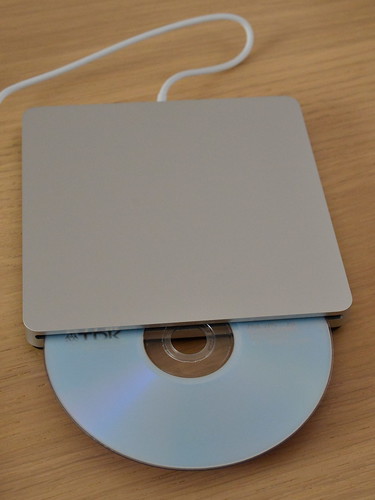
Apple only supports DVD players in their computers, some of them still have an integrated DVD player (those are disappearing in their new products) or have the possibility to connect an external one (Apple provides one for the MacBook Air range for instance). See above picture.

D4C_3066

The solution: consists of two elements: the BluRay player/burner and the required software.
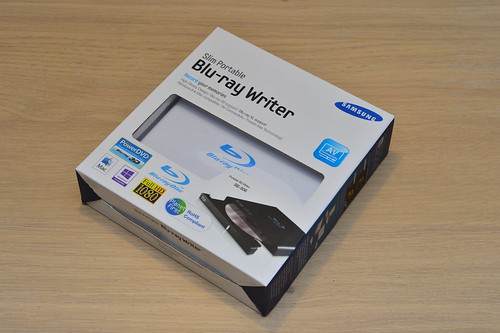
There are quite a few cheap BD burners available on the market. I selected a Samsung version based on several reviews I could find on the net. The advantages of this player are a relative compactness, the fact that it works with a single USB connection (and embedded power supply - no external power supply needed), and it is delivered with the PowerDVD software suite allowing to play BluRay's on Windows platforms.

D4C_3067

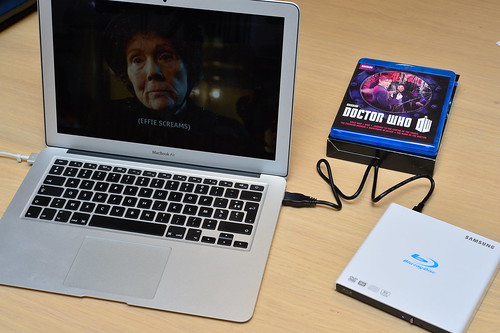
The player will automatically be recognised as a disc unit and you'll be able to play DVDs with the standard DVD player provided by Apple. To play BluRay discs, you'll need specific software. The good news is that freeware is available, next to commercial products. Moreover, the Mac software will make the use of BD more user friendly, most annoying videos/commercials/copyrights are skipped, you can almost directly watch the movie/TV series, a huge advantage.
See here, for instance, for more info:
http://download.cnet.com/Free-Mac-Blu-ray-Player/3000-13632_4-75891746.html

You're all set, you can watch your BDs on your Mac from now on...

Tuesday, February 26, 2013

Blu-ray - a real improvement ?

Blu-Ray could be the last physical video media before everything goes on line, and has been seen as a major improvement over the previous generation, the DVD. But is it a real improvement and did the designers really do a good job ? My answer is a big NO if you look at it from a quality perspective.

The first thing to take into account when developing a product is to collect the proper requirements (= the "voice of the customer" in quality terminology). It seems that this phase has not been done properly if at all.

What are the key requirements and the improvements expected over the DVD generation ? and what are the disturbing factors having a zero added value as far as the customer is concerned ?

- improved image quality, HD resolution : good job
- improved sound quality, more possibilities : good job
- more reliable media (scratch resistance, life time) : good job
BUT
- general performance of the system (reaction time, startup time) : ridiculously worse (a HUGE problem has been created where there was not problem: what would people say if after they start their engine, they cannot move the car unless they wait for five minutes)
- usability : an incredible step backwards. A complete nonsense user interface with an incredible number of manipulations instead of a single button press on the first DVD remote controllers.
- still a not so compatible system (very few PCs have a BD player, many cars have DVD players, no BD players, Apple does not support the format).
- regional codes: the distributors still don't understand anything about this market. This is an open insult to the user. You can legally buy a disc in a country, move to another (there are more and more world travellers) and you can throw away everything you bought. They just created another reason to STIMULATE piracy.
- languages: while at the beginning of the DVD, you had 8 spoken languages and 16 subtitles on a disc, nowadays you can be lucky if you find the right subtitles and the right language in a country far from the country where you live. This is really becoming ridiculous in Europe. If I live in Belgium, and want the original version (in english), english subtitles and the possibility to have french audio or dutch subtitles (the languages you would expect in Belgium) I often need to buy the discs in Germany, with the box in German.  This is true for DVD and BD by the way. This is in contradiction with the PRINCIPLE of DVD and BD, providing multilingual possibilities. And it is a nonsense for the distributors, who have to manage a huge variety of unnecessary versions while one single version for all of Europe would be easy.
- most discs do not allow to restart from a saved position. You start watching a movie. You stop. You want to see the rest the day after, NO WAY. You must restart and skip to the place where you left (if you remember it). A major step backwards again.

I don't know if I am the only one to think that way, but to me the BD, while being a reasonable commercial success (I personally like the pictures and I have a lot of BDs), is among the major engineering failures of the last twenty years: an extremely badly designed system, probably introduced by incompetent organizations in a hurry.

Friday, February 22, 2013

Testing Maturity Grid Concept


The testing maturity grid concept.

This is a concept I first encountered doing product development and that I found very useful to determine if a product development was ready for release to the market. The same principles or similar principles can be applied specifically to software development, whatever the type of development is. This can be typical IT application development, or embedded software or anything else.

The basic principle is to display the number of  problems/issues/bugs in a project in a grid form. The "look" of the grid will tell you in a very simple way if you are ready with your project.

The grid has to axes, the first one being the step in the bug workflow and the other dimension is the severity of  the bug.

The different typical categories are:

Bug workflow (inspired by JIRA, one of the widely used issue tracking systems):
- Opened
Meaning the bug has been entered by a beta user, a developer, a tester. The bug has not yet been analyzed or allocated (can evolve to in progress status, or be rejected, counted as duplicate, accepted, deferred or non reproducible)
- In progress
After first analysis, the bug has been allocated and is currently being solved but the final solution has not been implemented yet
- Resolved
The bug has been solved by the person it has been allocated to, it has been typically verified by the solver
- Closed
The solution has been validated by an independent tester or product owner
- Other end state: those are states which are equivalent to a closed state from a bug tracking point of view, in this category (they can be recorded separately), you can find states like: rejected (not an issue), duplicate (already recorded), non reproducible (not an issue ?), accepted (we/or the customers don't care), deferred/delayed (optional for a new release/version of the application - irrelevant to this instantiation of this project)

Bug severity
- Safety/security issues
The product cannot be used by actual users, in most cases even for testing purposes. For embedded software, it can imply safety issues up to life threatening issues (e.g. brakes not working in a car), for IT software, it can be related to major security issues (e.g. gaining access to strictly confidential information, legal consequences...)
- Unsellable
A required functionality is not available or not functioning properly making the usage of (part of) the delivered product impossible (e.g. a banking application where payments don't work).
- Major
A problem a normal user would find critical or even unacceptable but not making the application completely unusable (e.g. the software sometimes hangs but can be restarted)
- Minor
Even a critical user might tolerate the issue, it is in no way blocking to use the application or the product (e.g. a screen layout is not exactly as it should)

The maturity criteria also depend on the project phase
- Inception
- Elaboration
- Realization
- Transition

The grid

Severity->
Status
Safety
Security
Unsellable
Major
Minor
Opened
10
50
75
In progress
45
15
10
Resolved
20
10
5
Closed
2
10
10
5
Other
End state
1
20
5
15

If first limited prototypes are available to show a limited functionality, they cannot even show safety or security issues. Nothing can be released even to developers or internal project testing with bugs in the red area. The orange area can be acceptable during the realization phase, all types of issues  but the safety/security ones can be discovered and addressed.
After the realization phase, the product/application is being released to the final testing group (could be system testing, functional testing, beta testing), typically in a so-called acceptance environment. In that case problems can still be in the yellow zone. When the product is released to actual users/customers, typically in a so-called production environment, only the green area can be accepted.

The numbers indicated in the grid are the number of bugs/issues in a defined category/state, the example shown gives a status during the implementation (realization) phase.

Other information

The above is a specific interpretation of the concept: each organization can determine for itself the different steps in the workflow, the severity range and also the release and quality criteria for any phase of a project. Criteria might also depend on the domain area (medical devices, car industry, telecommunications, IT, public institutions...)

Another example of the same ideas can be found here:

Sunday, December 11, 2011

Scripta volant, verba manent.

HK3_5172
A very interesting situation: the Latin proverb everybody knows is (supposed to be) verba volant, scripta manent, which means, the spoken words fly away, the written words remain.
This conclusion is probably false. I remember what my Latin teacher told me more than 30 years ago, and the exact proverb was exactly the opposite. Scripta volant, verba manent. The exact meaning being: written words (on parchment) are ephemeral and literally fly away (many texts have been lost that way) while the spoken words (very often, the legends, the stories being told) are kept through generations of people. I remember my teacher explaining the details based on a very serious thesis. This explanation seems much more logical to me, considering the context (Antiquity). Amazing to see that one of the most popular proverbs in the world might be completely wrong.

Saturday, November 19, 2011

My last magazine


, originally uploaded by gugs.

I don't know about you, but since the introduction of the iPad, a huge revolution has taken place and I fundamentally changed my behavior. I don't buy magazines anymore, I mean paper magazines. The last one I am interested in and I CANNOT get electronically is Le Chasseur d'Images, a French photography magazine. All the rest I get electronically on my iPad, Popular Photography, Newspapers, Capital (French), Wired, iCreate, and many others via Zinio.
So far, so good. BUT, if you think of it and extrapolate on recent data, 180.000 more people read the NYT on the iPad a few days after the introduction of the Newsstand app, you can conclude that whole industries will just disappear in a matter of years. This will be a disastrous move on top of what is probably becoming the worst economical crisis in history. Worldwide, hundreds of thousands if not millions of people might lose their job just because of this paradigm shift. I am convinced, that on relatively short term, there will be no need anymore for the printing industry, the press shops, the book shops, the distribution, warehouses and transportation industry active on this market. Their market will shrink and will just vanish because their cost will become unaffordable. Just like videoshops are just disappearing slowly. Another strange paradigm shift nobody is talking about is the change in the financial model. Until now, when I bought a French magazine, all the money went to local people, and supported local jobs in the chain. When I do the same eletronically, more than half the money goes to US companies !!! And almost doesn't create any job at all.
Food for thought.

Wednesday, August 10, 2011

Ice cubes ?


BE7_4646, originally uploaded by gugs.
For whisky fans, an interesting way to cool the glass without having to use ice cubes (a shame to add water to good whiskies). An example of a creative/innovative solution to a (not so) simple problem (cool down without using ice). You have to keep the (cleaned) stones in a bag in a freezer, and put them in the glass when needed to lower the temperature. They are neutral and don't alter the taste.

For geeks only.

Sunday, July 24, 2011

Surprise your customers


IMG_0097, originally uploaded by gugs.

A special experience in one of the best restaurants in the world. During a visit to "Troisgros", among the top 50 gastronomy locations in the world, the waiter overheard a discussion about Apple, using iPads...  One of the people at our table didn't like cheese and asked if he could get a replacement. This was the result, a wonderful combination of caramel, light cheese, apple. The lesson learned: if you want to make an impression and increase your customer experience, having your customers talking about it (recommend you as a supplier), surprise them, by listening to their needs and giving them added value they don't expect. This might seem evident, but so true.

Sunday, March 27, 2011

Quality control


IMG_0147, originally uploaded by gugs.

This is an interesting example: a product made by a well-known european manufacturer. I bought this lamp with a few others and noticed the problem when I was back home. The glass is not only damaged (probably due to shocks during transportation, but also has signs that it has never been completed (melted edge)). There are no small glass pieces inside the package. This could mean that there is no basic quality control, not even a check if the lamp is working on the production line. This seems very strange to me because this is the first time I see such a problem (I must have use/bought hundreds and hundreds of lamps from the same manufacturer without a single problem). Anyway this shows the importance of basic quality control before selling products...

The iPad2 and iOS4.3

So, as everybody knows, the new iPad has been launched, and people are lining up all over the world to get one. Again, I wanted to post my personal view about the evolution.

First the very good things:

I already was very enthusiastic about the iPad as a consulting device and I really think the iPad (and maybe some competing tablets) is a bigger revolution than many suspect. Most computer users in the world are relatively passive (i.e. they typically use a PC to consult information, and sometimes to send a mail, to tweet or to type a short document, but they basically don't use the computer as a creative tool or a production tool). The iPad is a MUCH better device than anything else in the history of computing for those users. That is the reason why I think that some manufacturers could start worrying, because the iPad is a disruptive innovation as big as the CD replacing the LP, or the DVD replacing the VHS. Outside the consumer market, the potential is just huge, many industries starting to see the possibilities of simple apps to handle business processes. In other words, launching the iPad has probably been one of the smartest moves in the history of computing. Another fact is that the iPad has been the first one on the market with a very attractive business model (with iTunes, the available apps, the relative ease of access for developers), and it will be difficult for others to really compete with that eco-system. I don't expect real competitors in the coming two years.

The iPad2 is even better: to me the most convincing elements are the form factor (thinner) and the weight. Even if not exceptionally lighter, this does make a difference. The webcam is a major plus, I have been frustrated with the iPad1 after some months, because I couldn't show my face in skype for instance. More memory is also very welcome, the upper limit being reached very quickly on the original iPad. And an improved speed is also welcome, surfing being a bit slow on certain sites.

The good things:

iOS4.3 brings a few improvements (and a few bug corrections: I would expect MUCH more transparency from Apple about this, because even if we don't have to complain to much compared to the Windows community, the Apple products are definitely not bug free). Improved speed (surfing), the return of the orientation lock button. This was an UNBELIEVABLE basic design flaw in iOS4.2. I cannot understand how the Apple engineers could make such a stupid decision. I have been extremely angry with them after I installed 4.2. Problem solved in the meantime: they seem to listen to their users !

Some other improvements have been made available: Garageband app for iPad, Airplay improved... and a very interesting possibility to use your iPhone as a Wifi router if you don't have the 3G option on the iPad.

The not so good things:

First of all, for original iPad users, wifi problems are still there: wifi perfectly works at home on my router, but when I am traveling, the same HUGE design problem shows again: in every second hotel (approximately) during my last trip, I couldn't get a connection: this is a general problem with all first generation iPads, while other devices (PCs, telephones) could connect without a problem. I really hope Apple has redesigned wifi in the iPad2. I cannot understand why the Apple community is silent about this because every single iPad user I have met (a bit more than 20) had the same problem at the same locations ????

An important update on the wifi issue: after traveling even more, and even going back to one of the places where I first discovered the problem, it seems that the problem has been solved (could it be in the last intermediate release ?) I don't know. I had a few iPad2 users next to me. None of them have experienced the same issue as the iPad1 users. The only remaining small issue is that the iPad needs a stronger signal than other devices. My PC and Macbook were still detecting the network and could get a connection while the iPad was lost (when moving away from the antennas).

The camera on the back of the iPad2 is a nice gadget but I really didn't find a need for this. The iPhone camera is better and I don't see myself holding an iPad in front of me to take pictures... In fact it is a nice gadget to show where you are when chatting, but this was no "urgent" feature we needed.

My conclusion:
The iPad is not without flaws but it is by far the best information consulting device in history and has even improved with this second release.
And just for info: you can now find find cheap first generation iPads since the introduction of the iPad2: don't hesitate to buy one: they did't stop working :D !!!

Thursday, August 5, 2010

My take on the iPad


There is a lot of hype around the iPad and there are a lot of reviews available, many among them are pretty emotional (either the iPad is the best invention in history without any flaws, or it is the most ridiculous and the most expensive gadget ever). I'll try to give a different view on the new Apple product. I decided to go for a 64GB Wifi (non 3G) version.

 1) the concept is not really new

A user friendly device including
. A touch screen
. Screens with clustered icons representing applications
. Simple applications standard, like contacts, calendar, mail, ...
. Downloadable free applications
. Applications store
. Multimedia possibilities, video, audio
That thing was the Palm Tungsten.
What is really new is
. The form factor
. The multitouch inherited from the iPhone, IPod...
. A very nice high res screen
. Much more computing power
. The motion/orientation sensor
. A much better marketing
. The integration with iTunes and the appstore
. The modern communication possibilities, wifi, 3g...

 2) the form factor and the ease of use/user interface are THE differentiating factors

people who are criticizing the iPad probably never tried to use one.The whole experience is just amazing, there is no startup time, everything reacts as foreseen, most interactions are logical and intuitive. Here a small comment, there is no user guide with the iPad, you can download one on the Apple website and I would recommend to do so if you are not familiar with recent Apple products. Just an example: if you don't know it, you'll probably never discover all by yourself that you need to swipe from left to right to delete an item (a podcast for instant). After some time, you get so used to the iPad way of interacting that any other machine looks prehistorical in comparison. A system with a keyboard and/or a mouse is just so unusable and against all logic... This will be your conclusion. Applications are very well designed and really a joy to use. The App Store and iTunes on the iPad are really nice apps.

3) the iPad is not without MAJOR flaws and a few really minor ones

- the first big problem I had was the user experience with iTunes and the interface with the iPad.
I downloaded iTunes on my PC and the installation process crashed, corrupting the registry and a few processes, making internet access impossible, killing my firewall, and making my system totally unstable. It cost me more than 3 hours in total to recover a working system and to reinstall iTunes. Only after that I could enjoy the iPad experience in a normal way. On another machine, it took me 5 minutes to install and to configure everything properly (use the proper version BTW, 32 or 64 bits depending on the OS you are using)
- the second not so nice experience was a consequence of the first one, some functions were not working properly, Youtube being a problem at the beginning. This has to do with the fact that iTunes crashed my PC, and that I needed some time to recover a working PC: if you don't sync your iPad with iTunes, Youtube will not be reachable ("Cannot connect to Youtube" error). Once you have synced, everything works as foreseen.
- the third not so nice experience almost convinced me to bring it back to the shop and to forget the whole thing, I have been unable to do anything (buying/installing apps, surfing) for a few days because of the lack of working Wifi interface.
 In several locations, and ALL iPad users were affected in the same way, the Wifi was just unusable. I don't believe in pure chance: in the first hotel where I tried to use the iPad, I needed tens of tries to get a connection, having the Wifi bars oscillating between 1 and 3 bars in real time, losing the connection every few minutes, making the creation of an account on iTunes close to impossible (I succeeded after three days), and the whole iPad experience a total nightmare: five other users were there in the same (huge) bar with EXACTLY the same behavior, while something like 20 people were surfing using their PCs, Macs and iPhones without any problem at speeds up to 500KBytes/sec. In other words I suspect that ALL iPads in the world have an unusable Wifi interface. In a second hotel (smaller, maybe I was the only user of their Wifi network) and at home, no problem at all, I got a fast connection and everything was working properly. Move to another hotel a week later, public Wifi with access control: as displayed on the screen, in several locations on the resort, network detected, address allocated, no router... impossible to connect, again three users at the bar, somebody from the UK, another one from France and myself from Belgium, iPad bought in France, strictly the same symptoms, impossible to connect. Again, ANY other device connects with all the bars on without any difficulty. I found another place in the resort where I could connect, but only after I discovered a few tricks: the iPad was NOT capable of keeping the connection more than a few seconds (timeout problem ?), making the login process impossible: I had to switch between pages while typing my username/password and once in a while (typically after 5 tries) I could get in and have a semi-stable connection with a few interruptions.

Now what about Apple's reaction: they seem to know (I am cynical) that there is a problem: the last software release addresses Wifi issues: what happened: after the installation of the new software, nothing works but three bars are displayed all the time: what a joke !

A last update: I have been visiting friends this week, with a Wifi connection in a condo building, several users, I could get a connection but I lost the connection every few minutes, but the iPad was recovering all the time, in other words, serious flaw again but usable. Again, any other device did NOT show any problem.

My current conclusion is and I still need to be proved wrong: there is not a single iPad until now with a properly designed Wifi interface. On the Apple site they even recommend things like switching Wifi On/Off, upgrading the routers, using Wifi n only, what kind of joke is that again ?

Now, my conclusion should be taken with a grain of salt, because I really love the iPad and I am still recommending the whole experience because of all the wonderful things, and the fact that in practice I can manage (at home, among others) but this should be taken a bit more seriously by Apple.

The really minor issues
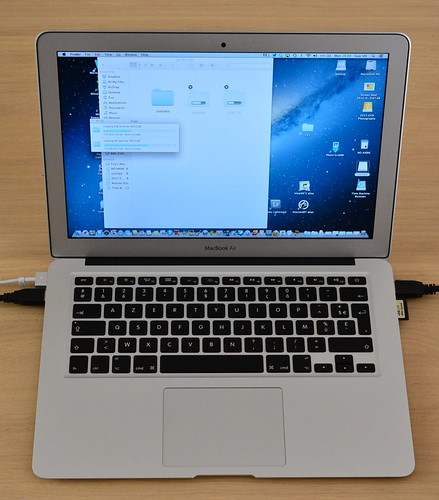
A post about the iPad would not be complete without a picture showing the nice "mirror effect" making the screen unreadable under the sun light, and the nice visible finger prints (here just after a complete cleaning and just a few manipulations)
It can take quite some time to backup the device on iTunes, if you download a lot (including videos/podcasts for instance), the whole process can take up to half an hour (everything has to go through the USB 2.0 interface not always using the whole bandwidth and you have to copy GBytes)


The official Apple cover (a very nice one BTW) is not compatible with the docking station !!! Are Apple engineers really using and/or testing their products ? A company with a decent quality department should never make that kind of mistake.

Certain international keyboard layouts are not interpreted/mapped properly (I have found this info on the net) if you are using an Apple wireless keyboard. This should/can be solved easily. I expect this problem to disappear because the supersexy Apple thin keyboards are a really nice addition to an iPad if you want to type faster. Update on this one: Apple wireless keyboards ARE compatible, but you have to select the appropriate soft keyboard BEFORE linking on bluetooth. A wonderful addition to the iPad when you need to type a lot of text ! Apple should give a better explanation on their sites for international users (non US keyboards).


4) as far as I am concerned, the wonderful things largely compensate for the flaws

- the user interface, the way you interact with the device is just logical, extremely easy to master and after a while, it even becomes difficult to understand how it is possible that people are still using computers with keyboards and mice. There are a number of killer applications making the whole experience exciting on the longer term: reading books is easy, comic strips get a new dimension, there are amazing simple and less simple games otherwise impossible (thanks to the orientation sensors, the multitouch interface). The reaction time makes me always grab the iPad to consult all kinds of information on the net, I don't use my PCs (laptops or not) a lot anymore, unless I need the power, the storage or specific interfaces, which is not all the time. I cannot accept the boot time or the "resuming windows" time on the PCs anymore.

5) the missing things ?

- a better design, allowing to dock with the cover attached
- some people are complaining about the absence of a camera or webcam. I am not sure this is a real need after using the iPad for a few weeks. Video conferencing could be a nice addition in the future, but this might cost a lot of power drain. Adding a camera to take pictures does not really make sense, looking at the form factor.
- a memory extension and/or SD card reader for file downloading is a missing element as far as I am concerned. The addition of the special kit (including a USB interface and an SD card reader) for photographers is a step in the right direction, but the main issue is that memory cannot be extended, not even externally.
- replaceable battery (I really wonder how the battery is expected to work after two years and how much they will charge to have a simple battery replaced).
- "multi-tasking" would be a wonderful addition (expected for November 2010), to be able to switch between application without losing the current work.
- a nice evolution would be a better screen, readable under the sun light.
- communication about the various versions is not very clear to say the least, there is a kind of confusion about the possibilities of the Wifi, Wifi+3G versions, regarding GPS positioning.

6) the killer apps (YMMV of course)

The reasons why I am using the iPad all the time are not the ones I initally expected:
- not a killer app but a major reason to grab the iPad: no boot time !!!
- reading books (novels), using the iPad as a Kindle
- reading comics (the common engine used by most readers is really nice to browse through pages, a really nice experience)
- surfing on the net is WAY better than with a classical computer thanks to the multi-touch user interface
- the games exploiting the specifics of the device like the multitouch screen and the orientation sensors (Labyrinth, driving a car, aso...)
- nice integration with the app store and iTunes shop

7) Local limitations

Something which hopefully will be solved in the future. The whole iPad experience is content driven, and that content is location dependent. Totally unacceptable for international travellers. If I live in Belgium, I am not allowed to download videos, I cannot buy American novels from the Apple store (well from Amazon). This is just ridiculous. Somebody living 100kms or miles from me has access to 10 times more content, for free or not. This should urgently be addressed. In a modern world those kinds of limitations do not make sense at all anymore. I can go to the UK (I do that) and buy books, order them from amazon.co.uk but I am not allowed to download a book from there ???

8) a few hints

- use the App Store on your iMac or PC, you will easily find the apps you are looking for. The iPad screen and the user interface are not (yet) designed to browse through enormous amounts of applications.
- use one of the available tools on the net to convert video content (DVDs among others) for viewing on the iPad, an interesting (free) choice being http://handbrake.fr/
- use the Goodreader app to view your docs (pdf) on the iPad
- try comic books (for instance Marvel) just for the fun
- using the iPad as a Photo Frame might be an expensive choice, but the image quality is very impressive, an ideal showcase if you want to show pictures to friends or customers.

9) Conclusion

The iPad is far from perfect, but other technology combos look so prehistorical after you have tried it. The user experience can be improved, there are some design flaws, but at the end, I always grab the iPad for a lot of things, instead of my laptop PC. The effect on the longer term can be/will be enormous, I even expect that some professions might disappear as a consequence of the introduction of the iPad (major leap in the direction of eBooks, Comics reading)

The Pros
. incredible ease of use
. excellent concept (stable, reliable, the advantages of a closed system)
. excellent screen
. overall performance (games, video, reactivity)
. battery life (up to 10 hours)
. close to zero startup time (this is really a killing one compared to ANY computer)
. very nice reading machine
. lots of appplications/possibilities
. design
. the iPad is a "cold" machine, you won't burn your legs because the back becomes hot !
The Cons
. serious design flaws (Wifi, docking...)
. expensive ?
. unusable under the sunlight (even in the shadow)
. closed system, fully depending on iTunes
. needs constant cleaning
. some technical limitations (allowed video formats, browser compatibility, Flash...)
. long charge time (4 hours +)
. unable to charge with most PCs
. charger/USB cable too short
. no real expansion possibilities 

Overall conclusion: highly recommended
Saturday, May 8, 2010

Californian Paranoia


various_-12, originally uploaded by gugs.

Something specific to California... this was on a small glass I bought in San Francisco. As usual in California, a serious warning for your health, but does it really make sense ? Based on the warnings I have seen, I should not have eaten anything in SF, because restaurants were serving products possibly containing lead, and all kinds of stuff resulting in cancer, the hotel I was staying at was using products causing serious health problems including cancer and so on, and so on. Two possibilities: either those warnings are really serious and the whole population should be panicking, and stop eating or drinking in such a dangerous area, or like everywhere else in the world, you can die from something and not caring about it would probably not influence your life at all. And back to the glass, if the danger was really serious, why is it even alllowed to sell it ?

Sunday, March 7, 2010

Batteries - interesting concept


DSC_4695, originally uploaded by gugs.

A creative solution to minimize the number of different batteries you need to store. Those are cylinders with a kind of clicking mechanism to hold normal AA batteries. The result can then be used as a "normal" C-size battery. The length is approximately the same (50.5mm instead of 50mm) which does not give any problem in practice. Highly recommended but very difficult to find...

Friday, February 26, 2010

Some fun with CMM-i

For the CMM(i) fans or users, there is an extraordinary presentation available on the SEI (Software Engineering Institute).

Have a look here: http://www.sei.cmu.edu/library/assets/mogilensky_07.pdf

A funny description of the "Blame Allocation" process, described in the same "professional" way as the usual CMMi processes. Very funny and creative... but in fact very close to reality: this seems to be THE only process perfectly under control in many large organizations. A must read for all people involved in process improvement.

An interesting fact is that the very serious SEI is hosting such a "joke" (a very intelligent one) on their site.

Highly recommended !

Friday, February 12, 2010

Software technology wiki

I just started a new wiki, with information and experiences with software related technology and processes. This will include software packages, open source or commercially available, information about process improvement, quality, tips and tricks (how to...). Feel free to contact me for more information and/or to contribute.

If you want to pay a visit:

http://www.techniphoto.com/tech

Monday, August 31, 2009

Software and statistical process control


MSP, originally uploaded by gugs.
This is a must read book for those who want to apply measurement to their software processes. It is in fact a book about statistical process control with a good introduction to all the charts and tests you can do, with a software flavour. Selecting the metrics to be used is very important and multiple examples are given in the book. An interesting companion is you decide to deploy a metrics programme in a software oriented organization (mandatory if you are using tools like CMM and you want to reach level 3 and 4..., or if you want to implement the measurements part in CMM-I)

All in: an accessible and highly recommended book.

Friday, August 28, 2009

SPAM: Skype vs Flickr

Something very interesting is happening on the net. It seems that sex workers or internet criminals have found a new way to access their potential "customers". Two examples of potential targets are flickr and skype. The criminal organizations basically exploit the fact that user lists (directories) are freely and publicly available, so it is quite easy for them to send millions of spam messages to those users in an automated way. But the way both companies are reacting to that is quite different:

Skype:
thousands of users get a invitation to contact an unknown person (often with a "sexy" name and to optionally click on a link). If you do click, you are "dead" because the link goes to a site with malware and typically installing a nice Trojan on your PC. Never click or react to such a request (I never ever did). The problem for Skype is that more and more users are complaining because they get several (up to 30 according to forum posts) unwanted connection requests/messages a day and there is NO way to stop this. Skype is just asking the users to "block" the person and to report the abuse. They are basically doing nothing even if they say they are working on it. From a user's perspective, this is a very wrong attitude because more and more people are complaining about this. Skype is just under attack by those spammers, and it just seems that they don't realize they could just disappear (I am serious) if they don't handle this issue in a professional way. I am not willing to use Skype anymore in the same way, and I am definitely not willing to pay a cent for a service which cannot be reliable and user friendly anymore, not even taking the potential extremely severe threat on your PC and its contents. Skype also almost "denies" the problem in a soft way on their forums, making the situation very unclear. Anyway the whole attitude is very unprofessional and will definitely destroy their image IF they don't address this quickly in a more serious way, and if they don't communicate clearly about the issue.
I am very curious about what is going to happen in the coming weeks, and what the press is going to tell about this.

Flickr:
A very different story, but basically another form of SPAM started yesterday (as far as I am concerned). People, most probably sex workers linked to criminal organizations are creating users and leaving comments on your pictures (flickr is a picture sharing community), with a strange message including a request to comment on their pictures. They typically have only one, and it is a way to get you on a sex site or to contact a sex worker. The approach was VERY different from Skype: within a few hours the users who started this spamming have been deleted (I have seen the same messages by other dummy users appearing on several friends' pictures within minutes so it seemed to be a general issue). And later the messages have been deleted and everything has been restored. Not only the reaction was extremely fast, but the users themselves didn't have to do anything and many probably didn't notice this was happening. We'll see how the situation evolves, but this approach at least, is much more professional than in the Skype example.

This is to me another real life example about the paramount importance of listening to the customer (VOC voice of customer) at all times and to differentiate by pleasing him/her, the best longer term investment you can do...

Recent update:

as far as I could check, flickr did not experience that kind of spam recently, at least in a visible way, while skype users still regularly are getting annoyed by spam. They partially solved the issue, because it is happening once a week maybe on average, while it has been a lot of times each day. Not so many people are complaining and it does not seem to have an influence on their business. Strange sometimes how people react.

Friday, August 21, 2009

We are trying harder...

A simple comment about the "voice of the customer". The AVIS car rental company is using "We are trying harder" in their marketing communication. I have used AVIS quite a few times and have always been (very) happy with their service and price/performance ratio BUT the message is strange to say the least. As a customer, if I have a problem, I don't want my supplier to "try harder" than the competitor, I want a reliable supplier solving the problems or not creating the problem in the first place. The message is quite defensive and sounds very negative to me. I would be curious to hear the perception other users might have, I consider this giving a negative image of the company...If we are thinking of this in an NPS context (net promoter score) - a concept using a simple metric based on customer satisfaction to determine the potential of a company - I would give a high score to AVIS based on my personal experience, but the "try harder" message could be damaging the score: who wants a supplier "trying" something, everybody wants suppliers "doing" their thing.

Friday, August 7, 2009

Poka yoke hotel keycard


scotland -41, originally uploaded by gugs.

This is a very simple example and a creative one. A card manufacturer decided to slightly adapt the shape of the keycard. A s a result, you insert the card with your finger on the "right" place and don't have to retry different orientations...

Friday, May 8, 2009

Strange world

A recent experience showing again that we are living in a crazy world (that I already knew for a long time). I learned a lesson about pricing and about the nonsense world economy and traveling products. The story is as follows: some products (I don't want to mention details, this is not really relevant) available on Amazon are cheaper if they are ordered from amazon.com than from amazon.fr for instance. As a European, I order some stuff from the .com site, and goods are supposed to be delivered from the US to Europe. Now the path being followed: the products in question are produced/printed in the US, distributed by a company in California. According to the package I received, it seems that the goods have been shipped from Auckland, New Zealand. Delivery was in Belgium, Europe, with a very reasonable delay and perfect packaging. 5 stars service. But what about the number of miles traveled, everything for a lower charge than similar products delivered from the European warehouse...

This kind of story is not new, of course, and BTW I am a happy customer, but as said in the beginning, we live in a crazy world.

And just for the fun, I just saw that the apple I was eating while typing this is coming from New Zealand too. We produce apples locally, not in this season, but again...

Thursday, November 13, 2008

Letters

Sometimes brand name and logo are so strong you can recognize the brand just by having a look at one single letter using their standard font... here is the "company" alphabet... guess who is who